Why Modular Construction Delivers Velocity Through Discipline
One of the things I've learned building homes throughout the Rockies is that construction schedules are rarely controlled by how fast people work. They're usually controlled by everything that gets in the way of the work. Weather. Inspections. Material delays. Trade availability. Site access. One subcontractor is waiting for another to finish before they can begin.
In mountain communities, those challenges are often amplified. A delayed delivery, a snowstorm, or a stretched-thin trade partner can impact not just a day or two of work, but the entire sequence of events that follows.
That's one of the reasons I became interested in modular construction years ago. I was fascinated by how the integration of two construction methods leads to a better way to build.
Most people think modular construction is faster because things are built differently. In my experience, the biggest advantage is much simpler than that: We spend more time planning and less time waiting.
Traditional Construction Is Sequential
A traditional site-built home follows a fairly linear path. Site work leads to foundations. Foundations lead to framing. Framing leads to mechanical, electrical, and plumbing rough-ins. Then insulation, drywall, and finishes.
There's nothing wrong with that process. It's how homes have been built for generations. The challenge is that each phase depends on the one before it. If the foundation is delayed, framing is delayed. If framing is delayed, the trades are delayed. If inspections are delayed, everything behind them shifts as well. The work itself isn't necessarily slow. The process creates waiting.
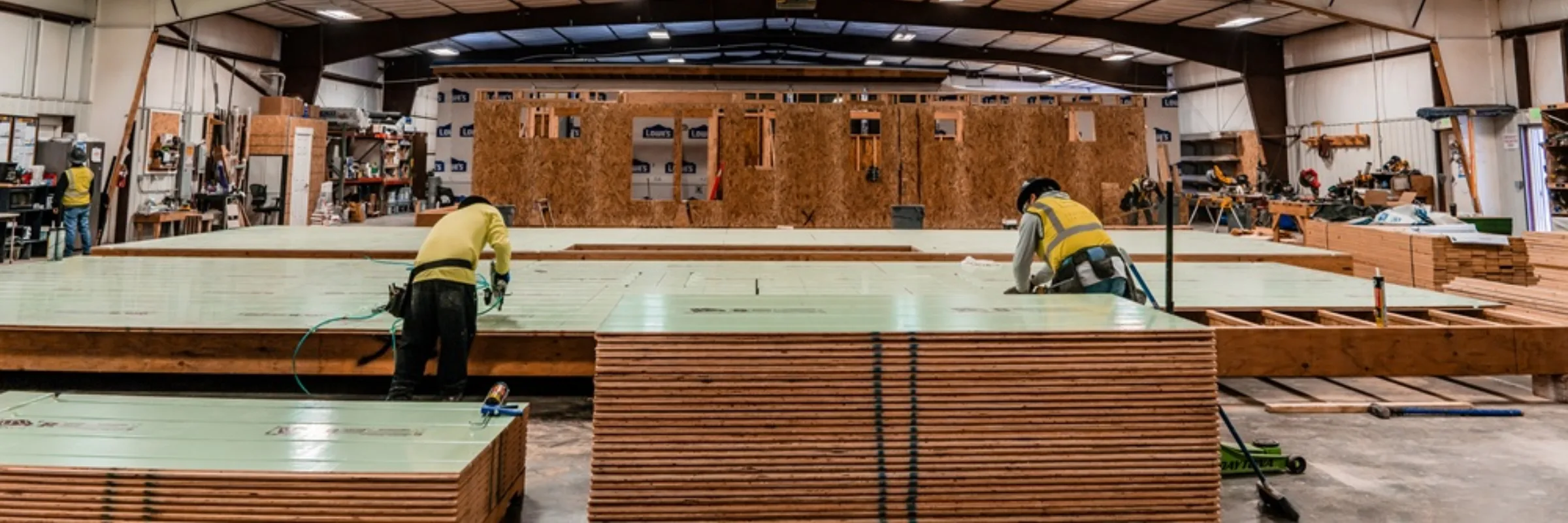
Modular construction changes that equation. While site crews are preparing foundations and utilities, the home is already being built in our production facility. Instead of a single chain of events, multiple work streams are happening at the same time. That's where much of the schedule advantage comes from - and the results can be as significant as a 30-50% schedule compression.
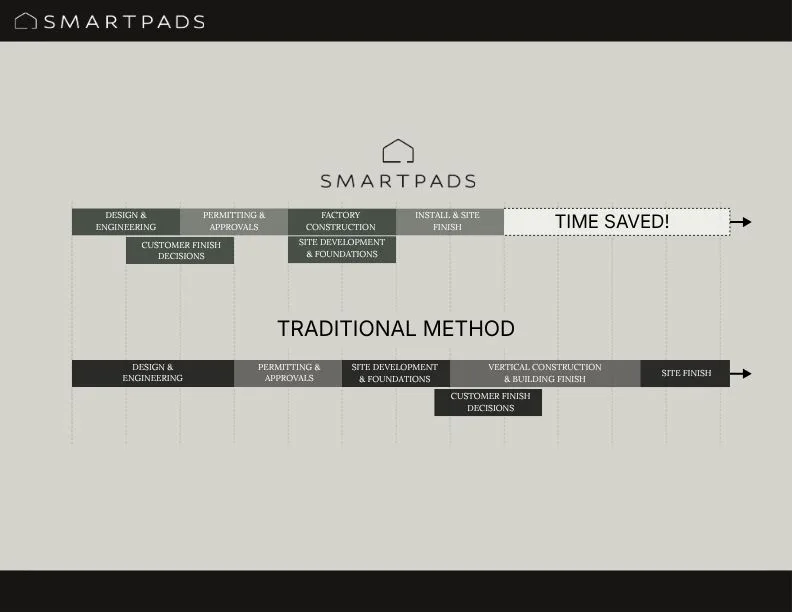
When people look at a chart like this, one thing becomes obvious: much of the schedule advantage comes from overlapping activities that would traditionally happen one after another. While site work is happening, the home is already taking shape in our production facility.
At the same time, some parts of the work genuinely move faster in a controlled manufacturing environment. Production isn't regularly interrupted by weather, materials are readily available, and crews can focus on their work without many of the variables that exist on a traditional jobsite.
The result isn't speed for the sake of speed. It's a more coordinated process that reduces waiting, minimizes disruption, and keeps projects moving forward. Ultimately, that saves time—and time often saves money.
Front-Loading Decisions
This is one of the biggest differences homeowners notice when working with SmartPads. Modular construction requires decisions to be made earlier in the process. Window and door packages. Mechanical routing. Cabinet layouts. Electrical load planning. Finish selections.
In traditional construction, many of those decisions can drift into the field phase, where changes are often expensive and disruptive. At SmartPads, we have in-house design and professionals that understand our product and process. Our team has developed a standardized process both internally for quality control, and for effectively guiding our customers to make their choices in an efficient way. I see it as one of the biggest advantages of the process.
When decisions are made earlier, there are fewer change orders, fewer conflicts between trades, fewer procurement surprises, and fewer schedule disruptions. In many ways, the projects that feel the calmest during construction are often the ones where the most work happened before construction ever started.
The chaos gets removed during design instead of showing up later in the build.
Manufacturing Discipline vs. Field Variability
Anyone who has built in a mountain town understands how many variables exist on a job site. Weather changes. Crews move between projects. Deliveries get delayed. Materials are exposed to the elements. Inspections create bottlenecks. Even the best-managed projects deal with these realities.
Modular construction shifts much of the work into a controlled environment where conditions are far more predictable. That creates advantages beyond schedule. Climate-controlled production helps manage moisture exposure. Standardized quality-control processes improve consistency. Materials are protected. Task-to-task coordination is streamlined. Measurements are verified digitally. Waste is reduced with up to 30% less material waste.
From a building science standpoint, this matters—especially in high-performance mountain homes where envelope control, air-tightness (ACH50 targets), and thermal continuity are critical.
The Financial Impact of Time
Construction schedules aren't just about convenience. They're also about capital. Every month a project remains under construction carries a cost.
For a $1.3 million project, reducing the build timeline by 8–10 months can:
- Lower construction loan interest costs
- Reduce the amount of time capital is tied up in the project
- Allow developers to turn equity into the next project sooner
- Get homeowners into their homes earlier
It's one of the least visible benefits of efficient project delivery, but frequently one of the most significant.
Speed Is a Byproduct of Discipline
People often assume speed and quality sit on opposite ends of the spectrum. In my experience, the opposite is usually true. The projects that move efficiently aren't the ones that rushed. They're the ones that planned. They invested more time in design. More time in engineering. More time in coordination. More time making decisions before construction started.
That's why I don't think of modular construction as a faster way to build, but rather a more disciplined way to build. The speed simply happens to be one of the outcomes.